

To take risks and deal with uncertainty today, to achieve outsized returns at an as yet unspecified later date is, I believe, the kernel of what it means to be an entrepreneur.
Entrepreneurs strive, not just for the consequential cashflows from their ingenuity, creativity, calculated risk taking and enterprise, but to leave their mark on the world. Together entrepreneurs toil towards a vision that leverages the natural laws of capitalism for the prosperity of all.
I’ve been privileged enough to pursue this auspicious career for eight years at the time of writing (June 2026). It is the very uncertainty that fortune will grant me the freedoms of another two, twelve or twenty years in opus that is the prime motivator. To be able to swing for the fences and miss (or more commonly, fall slightly short) and swing again, and again, and again in aeternum is intrinsically a privilege that too few of us afford ourselves.
It is misguided to assume the end point; be that the yacht, the holiday house, the now obsolete concept of a retirement, or even the more noble concept of having achieved one’s vision, is the reason for all the grift. As we’ve already defined, entrepreneurs take risks today for outsized returns at an uncertain endpoint. And the unspecified nature of the end point is exactly the point. To succeed in the long run, entrepreneurs must delight in the actions and mechanics of the day to day.
Politically and economically, entrepreneurship has traditionally been viewed as a vehicle for the creation of jobs. Perhaps inevitably for an entrepreneur who has made their fortune in the labour-intensive hospitality sector, Luke Johnson the backer of Pizza Express, Gail’s Bakery and Brompton is in alignment with this viewpoint:
“I believe it is a very basic instinct from early childhood to want to make a positive difference to society. Creating an enterprise is perhaps the most effective way of doing that ever devised. What can be more important than actually creating jobs?[1]”
Partner at Balderton Capital and contemporary commentator James Wise broadens this definition of entrepreneur as not just those who set out to make employment for others.
“More than 60% of business owners in the USA never go on to hire more than one other person… Small- and medium-sized enterprises (SMEs) account for over 90 per cent of businesses and 50 per cent of employment of the worldwide population. In the most populous countries in the world, such as India, over 90 per cent of the working-age population are employed in the informal sector, sharing many of the precarious risks and volatility in earnings as entrepreneurs do.[2]”
Wise hits closest to the mark in my view. The willingness to take risk and question the status quo are intrinsic to entrepreneurship and human progress more broadly. It is this risk-taking mindset, more than one’s ability to flatter ego by providing employment that unites the dispersed group of vagabonds and self-starters that identify as entrepreneurs.
The instinct to take risks in defiance of the majority view can lead to more miss and pivot moments than home runs, but the majority is wrong more often than you might think.
When the majority sell in a bear market, the entrepreneur accumulates.
When the majority go Mag 7, the entrepreneur will be improving physical letters.
When the majority go hire purchase, the entrepreneur goes Peugeot 205.
When the majority goes all-inclusive, the entrepreneur sails the Atlantic.
When the majority sell their time for money, the entrepreneur sells someone else’s.
Curiosity to the point of seemingly obtuse contrarianism is a defining characteristic of the entrepreneur. Indeed, the differences between the majority, those that seek safety and assurance by looking to the actions of others to decide upon their path and often hoarding their monies in the process, and the entrepreneur who consistently questions, innovates and puts their money to work as capital has precedent in economic theory.
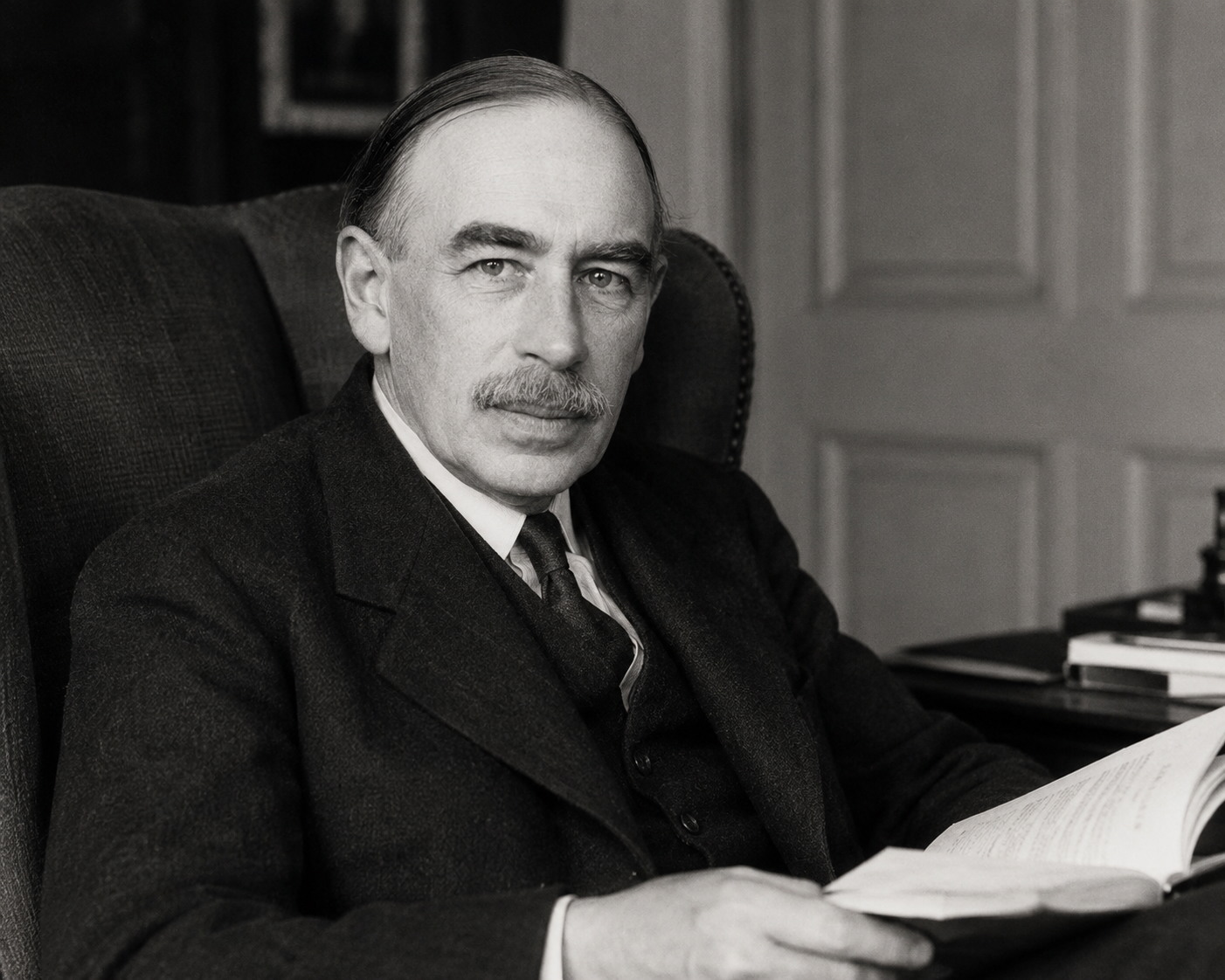
The founding 20th century economist John Maynard-Keynes in his seminal General Theory of Employment, Interest and Money (1936) stresses the importance of entrepreneurship as a vehicle for the effective deployment of capital in his concept of the “Liquidity Premium”:
“That the world after several millennia of steady individual saving, is so poor as it is in accumulated capital-assets, is to be explained, in my opinion, neither by the improvident propensities of mankind, nor even by the destruction of war, but by the high liquidity-premiums formerly attaching to the ownership of land and now attaching to money. I differ in this from the older view as expressed by Marshall with an unusual dogmatic force in his Principles of Economics, p. 581[3]:
‘Everyone is aware that the accumulation of wealth is held in check, and the rate of interest so far sustained, by the preference which the great mass of humanity have for present over deferred gratifications, or, in other words, by their unwillingness to “wait”.”[4]
Keynes’ Liquidity Premium is the extra value people attach to holding an asset simply because it is easy to convert into cash quickly, without losing value in the process. Money is the most liquid asset there is. You can spend it instantly, on anything, at any time. Before Keynes’ time, feudalism ensured that land held a similar premium, because owning land gave you the flexibility, security, and social power that other assets couldn’t match.
Keynes’s argument opposes Marshall’s: people don’t hoard money because they are impatient and want to spend it now. They hoard money because holding money feels safe. Having liquid assets like cash, or formerly land, gives people a sense of security and optionality that they value so highly they are willing to forgo the productive investment that would generate real wealth.
The consequences of this hoarding are being felt by the UK at present. Capital is sitting idle. Instead of being invested into businesses, equipment, and productive enterprise that would compound over time, wealth has been accumulating in liquid but unproductive form. The economy suffers not because people are spendthrift, but because they are too attached to holding liquid assets rather than deploying them.
I started my career as an entrepreneur eight years ago, with below average grades, thirty thousand pounds, a phone book and a new family to support. If I can do it, you can too, only much better.
The vicissitudes are not to be underestimated. But for some of us there is only one path. So stop hoarding, take action today and start it up. Your legacy awaits.
Alex – 25th June 2026
[1] Johnson, L. (2011). Start it up: Why running your own business is easier than you think. Portfolio Penguin.
[2] Wise, J. (2023). The startup century: Why we’re all becoming entrepreneurs and how to make it work for everyone. Bloomsbury.
[3] Marshall, A. (1890). Principles of economics. Macmillan. (As cited in Keynes, 1936)
[4] Keynes, J. M. (1936). The general theory of employment, interest and money. Macmillan.